Showing posts with label S06sf. Show all posts

Friday, October 13, 2017

Season 6 superfinal stats

Season 10 is less than a day away, I conclude my season 6 superfinal series with the statistics page I usually post after a stage is over. This is also a way for me to remind myself how I do this and to make sure that the scripts still work.

Next post - season 10 stage 1, first few rounds !! 

Draw rate, wins

 
Final draw rate was 70.3%. There were 19 decisive games, 3 of which were black wins.

Game termination

The three most common game termination causes were:
35% - TCEC draw rule
30% - TCEC win rule
27% - 3-fold repetition

Tablebase termination was quite rare in season 6, only 6 games. This is probably due to the fact that only 5-man tablebases were used for termination.

Moves per game


Median=53.5
Average=57.6

There were 4 games with more than 100 moves, usually draws containing very long boring shuffles.

Time per game (hours)


Median= 3:57
Average= 3:59

Openings

The first letter of the ECO codes of the superfinal openings was distributed as follows:


Cato's chosen openings for the superfinal covered all classes, a little biased for closed games (D) and indian defences(E).

If we use the opening 'family name' (using format FAMILY_NAME: VARIANT....) the top 3 are:
Slav - 10 times
King's indian - 7 times
Sicilian - 6 times

Each opening had 8 predetermined moves, and almost all the reverse pairs had the same ECO code, even the same full opening name. The one exception was unusual, game 59 had an ECO code of C05 and game 60 had an ECO code of E75.

Reverse pairs, wins


There were 4 cases of an opening with two white wins, potentially a biased opening. 


Reverse pairs, same moves

How many plys did the engines play after book until the first divergence in the reverse games?


Most games (59%) repeated at most 1 full move, only 19% repeated more than 3 moves.  The longest repeat was 9.5 moves in games 55 and 56.

Wednesday, October 4, 2017

Season 6 superfinal, games 59-64

This is part 11 (last one) of my looking back at the Komodo-Stockfish superfinal match of season 6. Previous parts can be found at
part 1, games 1-8
part 2, games 9-16
part 3, games 17-24 
part 4, games 25-28
part 5, games 29-32 
part 6, games 33-36 
part 7, games 37-40
part 8, games 41-48
part 9, games 49-52
part 10, games 53-58

After 58 games Stockfish led 13-5 with 40 draws.

In game 59 Stockfish had a small eval advantage for 30 moves, it was up an exchange but had an exposed king, while Komodo's pieces were better placed. Evals quickly fell to zero in a RRN vs RBN position, Komodo sacrificed a piece to get a strong passer, Stockfish had to give a rook to stop it and the game was drawn.
In game 60 Komodo was up on eval and up a pawn. Stockfish countered with a rook sacrifice and a strong king side attack to force a repetition draw.

Stockfish started game 61 two pawns up with and an uncastled king that already moved. Komodo had the initiative and a queen side attack. Stockfish first gave a rook for a knight and then exchanged most pieces losing a little more material to get to a R vs RB ending with three extra pawns. The evals were zero and the game was adjudicated as a draw.
In the reverse game Komodo gave back one pawn early, then marched its king away from the center while Stockfish gained two more pawns. The evals became zero in a QR vs QR position, leading to a drawn queen ending.

Game 63 started with a king's gambit in a sharp but relatively balanced variation. After a few exchanges both kings found refuge on the queen side, and though Stockfish had a small eval advantage the position became stable with long pawn lines. Most pieces were exchanged by move 30 and the game reached a double rook ending. The position remained balanced, it took a while but the game ended in a draw.
In the reverse game 64 Stockfish gave three minor pieces for a queen almost immediately after the opening. It thought the position was balanced while Komodo's eval>0.6 indicated it was happy with this imbalance.


After moving the king to safety on the queen side Komodo used all its pieces to put pressure on the black king. Stockfish was very passive with no counter attack, and its eval started to increase. Komodo's knights took over the center and the black pawns became targets.


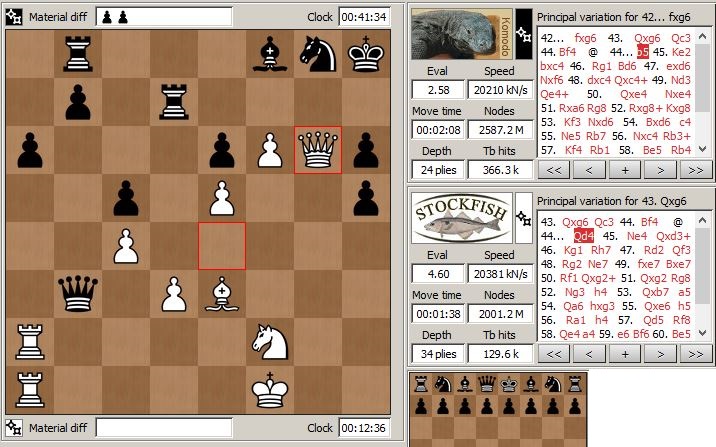
After exchanging a pair of rooks Stockfish only had QR to defend, outnumbered by Komodo's minor pieces. When the black king moved to the center to help it became a target for attack. Stockfish's position soon collapsed and the game was adjudicated before it started losing material. Komodo managed to win the last game of the match.

The final result of the superfinal was a Stockfish win, 13-6 with 45 draws.

Friday, September 8, 2017

Season 6 superfinal, games 53-58

This is part 10 of my looking back at the Komodo-Stockfish superfinal match of season 6. Previous parts can be found at
part 1, games 1-8
part 2, games 9-16
part 3, games 17-24 
part 4, games 25-28
part 5, games 29-32 
part 6, games 33-36 
part 7, games 37-40
part 8, games 41-48
part 9, games 49-52

After 52 games Stockfish led 12-4 with 36 draws.

In game 53 there were many exchanges after the opening with only RRB vs RRB remaining on move 18. Stockfish had a small eval advantage and better placed pieces, and a potential pawn advantage on the queen side.


Komodo's rooks remained passive and its king could not leave the king side, while Stockfish's king moved up the queen side. After exchanging bishops Stockfish's eval advantage was over 2.


Stockfish captured the black c pawn and Komodo's defense crumbled. After exchanging a few pawns and a pair of rooks Stockfish had two advanced passers on the queen side which were decisive.

The reverse game 54 started in a similar sequence of moves, again with only RRB vs RRB left on move 19. Komodo had a small eval advantage and an advanced passer, but since the bishops were of opposite colors the position was more drawish.


There were a few pawn exchanges which simplified the position. Komodo held to its strong passer and doubled rooks on the e file, Stockfish tried to defend with only a little room to move. The evals climbed above 1 for white, Stockfish's eval significantly higher.


There were several shuffling moves and it seemed that Komodo could not find a way to break through the black defense. Stockfish then advanced its g pawn, and in the new position Komodo found a path to victory. Stockfish sacrificed a pawn on the king side to gain a passer on the g file, but with Komodo controlling g1 with its bishop and with a pawn advancing on the f file the game was soon over. What would have happened if Stockfish continued shuffling? My guess - a draw. Stockfish prepared for a threat Komodo did not see.

Game 55 started with many exchanges that left RBN vs RRN after move 21, Stockfish an exchange down but with two more pawns. The evals were a little in white's favor but after exchanging a pair of rooks the evals dropped to zero. The pawns advanced as far as they could and the position became static, ending the game in a repetition draw.
The reverse game started similarly, reaching a RBN vs RRB position after move 21 and Komodo with an extra pawn. The evals were close to zero when Komodo chose to give back the exchange, it had an advanced passer and a centered king in a RB vs RB ending. Stockfish had no problem holding its position, it took another 20 moves but the game ended in a draw.

Game 57 was a 22 move miniature that ended in a repetition draw, while Stockfish was two pawns down. It is interesting to note that Stockfish saw the outcome in its PV starting from move 10.
In game 58 Komodo avoided an early queen exchange, Stockfish had a pawn advantage in a closed position. After a few exchanges the position opened with QRB vs QRB remaining, and the evals dropped to zero. Komodo gave a pawn and ended the game with a perpetual check.

After 58 games Stockfish leads by 13-5 with 40 draws. There are only 6 games remaining so Stockfish will win the match, regardless of the results of the last games.

Monday, August 28, 2017

Season 6 superfinal, games 49-52

This is part 9 of my looking back at the Komodo-Stockfish superfinal match of season 6. Previous parts can be found at
part 1, games 1-8
part 2, games 9-16
part 3, games 17-24 
part 4, games 25-28
part 5, games 29-32 
part 6, games 33-36 
part 7, games 37-40
part 8, games 41-48

After 48 games Stockfish led 11-3 with 34 draws.

In game 49 Stockfish had advanced passers on the queen side while the evals stayed close to 0. Stockfish was able to march one pawn to the 7th rank where Komodo blocked it. After queens were exchanged Komodo countered with pawns on the king side, both engines ran out of ideas and agreed to a draw.
The reverse game was much sharper. Stockfish sacrificed a knight for pawns, then broke through the center and threatened to win material with a QR skewer by a bishop. Komodo chose to give its queen leading to a RBB vs Q and pawns imbalance. Stockfish's eval was at 0 while Komodo thought it had a small advantage. It took a few exchanges and 30 more moves for Komodo to see that it could not penetrate Stockfish's defense.

Game 51 started with a small eval advantage for Stockfish. Both engines played moves that were expected in their opponent's PV and evals stayed low until Stockfish's pawns advanced on the king side.


Stockfish's king was exposed but Komodo was under too much pressure to do anything about that. With a bishop and knight trapped on the king side Komodo could only wait while Stockfish arranged its pieces for an attack. With the black queen on the opposite side of the board Stockfish opened up the king side.


The evals shot up as Komodo could not defend its king without losing material, especially after f7 was played. Stockfish won a few moves after that.
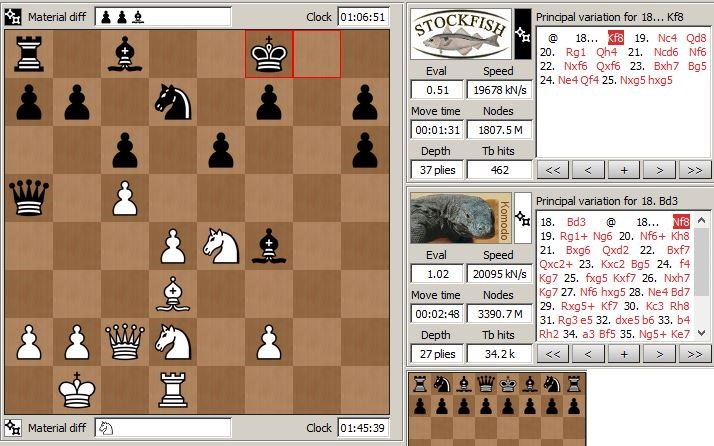
The reverse game 52 repeated the opening moves and the evals stayed low. Komodo chose to keep its king side pawns close to the king and Stockfish's king looked secure. Then Komodo managed to trap a knight and Stockfish took two pawns for it, leading to the following position:


Komodo had an extra knight while its king had no shelter. On the other hand Stockfish's pieces could hardly move (except the queen). Stockfish spent several moves to free its bishop while Komodo advanced its knight to a strong forward position. Komodo's eval gradually increased, while Stockfish's eval increased much faster, almost 2.5 as the bishops were exchanged. Then for a moment it seemed that Komodo blundered the win, Stockfish's eval dropped below 1 and it anticipated a drawn ending. Komodo had other plans as it threatened a mate in 1.


Stockfish was completely surprised, it immediately saw that the game was lost with evals shooting above 4. The game was over a few moves later. A rare Komodo win, and very uncharacteristic behavior for Stockfish's eval function.

After 52 games Stockfish leads 12-4 with 36 draws.

Tuesday, November 1, 2016

Season 6 superfinal, games 41-48

This is part 8 of my looking back at the Komodo-Stockfish superfinal match of season 6. Previous parts can be found at
part 1, games 1-8
part 2, games 9-16
part 3, games 17-24 
part 4, games 25-28
part 5, games 29-32 
part 6, games 33-36 
part 7, games 37-40

After 40 games Stockfish led 9-3 with 28 draws.

Stockfish was very happy after the opening of game 41, it had a knight for two pawns advantage and a queen side passer, as well as an eval over 1. Komodo had strong central pawns and as they advanced they started to look dangerous. Komodo then allowed Stockfish's knight to make a QR fork and gave a rook for the knight. Stockfish's eval jumped over 2 but Komodo saw a way out. Starting from move 41 both engines agreed on a 10 move sequence that removed most threats and left a QB vs Q ending. The evals were high but with almost no pawns left Komodo's queen was sufficient defense and the engines shuffled until a draw was agreed.
The reverse game was a lot less eventful. Stockfish gave two pawns on the king side to Komodo's queen, and this allowed Stockfish to force a repetition draw by attacking the queen.

In game 43 Stockfish again had an eval advantage after the opening, with a pawn up and a queen side passer. Evals clmbed to about 1 and stayed there for a while, but after several piece exchanges evals came down again. The game reached a drawn queen ending.
In the reverse game 44 Komodo started with the same pawn advantage and queen side passer. Stockfish exchanged queens and equalized before move 20.

Stockfish kept the initiative, got rid of Komodo's passer and the evals climbed above 1. After several exchanges Komodo's pieces could only hope to defend and block against Stockfish's threats.


For more than 15 moves it seemed Komodo was holding on, the engines were shuffling and the evals remained constant. Then after what appeared to be two blunders Stockfish exchanged B for N, the evals shot up and Komodo got itself in a world of trouble.

The c3 pawn was pinned and could not be defended. A few moves later Komodo's position collapsed, it faced queening threats and was about to lose material. Did Komodo really blunder the ending or was it going to lose in any case?

There were many early exchanges in game 45, with only RRB vs RRB remaining after move 25. Stockfish was a pawn up but with opposite color bishops that was not enough. After the rooks were exchanged the position was a drawn bishop ending. In game 46 again Stockfish was ahead with evals over 1.5 after sacrificing a bishop for pawns in return for a strong queen side attack on the white king. Komodo gave its queen for a rook and got out of immediate danger. In the RRN vs QR position it seemed the engines were shuffling with no real progress and evals did not move much. It took the engines more than 50 moves to realize it was a draw and 10 more for adjudication.

After the opening of game 47 Komodo kept playing moves Stockfish didn't expect. Komodo's eval stayed close to 0 while Stockfish's was close to 1. Then on move 21 Stockfish had enough, this time its eval shot up to over 2.


By playing d5 Stockfish blocked the center, making it hard for Komodo to move pieces around. This move also chased away the knight and opened up the diagonal for the bishop on f2. A few moves later Komodo realized it was in trouble after Stockfish sacrificed the bishop and exposed the black king.


Komodo could not defend against all the white pieces converging on its king. The game was over by move 33 before Stockfish gained enough material to force a win. It's very unusual to see such a short decisive game at this level.
The reverse game 48 developed along very different lines. Both engines castled to the queen side, Stockfish opened the e file and exchanged rooks and queens through it. The evals were never far from 0 and the game continued until the engines reached a drawn tablebase position.

In the last 4 openings Stockfish got 2 wins and 2 more games where it had a significant advantage and Komodo managed to draw. Komodo could not achieve anything in these openings, it is now trailing 11-3 with 34 draws and has no practical chance to win the match.

Saturday, April 30, 2016

Season 6 superfinal, games 37-40


This is part 7 of my looking back at the Komodo-Stockfish superfinal match of season 6. Previous parts can be found at
part 1, games 1-8
part 2, games 9-16
part 3, games 17-24 
part 4, games 25-28
part 5, games 29-32 
part 6, games 33-36 

After 36 games Stockfish led 7-3 with 26 draws.

In game 37 Stockfish had advanced pawns on the queen side, but its king was vulnerable on the king side. Komodo gave a pawn while keeping the pressure with its queen and knight, seeing potential repetitions or perpetual checks as a probable outcome.


Stockfish kept a small eval advantage and continued to advance pawns on the queen side, ignoring black's attack. Komodo was sure that a repetition has started on move 39, but Stockfish did not go along with this and let its king walk away from the black QN combination.

It turned out that Stockfish was right. Once the threat of perpetual check was gone the white queen side pawns became a big advantage. Eventually Komodo had to give a rook to get rid of the white pawns. The resulting QRB vs QN endgame was not easy but Stockfish managed to get the queens exchanged and the game was soon over.

The reverse game was less eventful. Both kings were safe, there was some action on the queen side due to an open file, but the evals drifted down to 0 after 24 moves and stayed there until a draw was reached.

Game 39 started with a small eval advantage for white. Stockfish used a pawn attack on the king side, exposing its castled king while maneuvering a knight to h6.


Komodo's king and rook were trapped. With the f file open Stockfish applied pressure to f7, and Komodo had less space to move and defend. After a series of exchanges in the center by move 40 the position opened up. Komodo exchanged RP for BN, but the trap in the corner meant Stockfish had a full bishop advantage in the center.

After forcing a queen exchange Stockfish continued to clear some of the pawns. Komodo broke out of the trap by exchanging the rook with the trapping knight. The resulting RB vs R endgame was a clear win for Stockfish.


In the reverse game Komodo did not move its king side pawns and both kings remained safe. By move 24 both evals reached 0, and it was only a matter of time until the game was adjudicated. That's twice in a row that Stockfish had a clear win over Komodo in a pair of reverse games. With 24 games remaining it is very unlikely that Komodo can win this match.

Sunday, April 10, 2016

Season 6 superfinal, games 33-36


This is part 6 of my looking back at the Komodo-Stockfish superfinal match of season 6. Previous parts can be found at
part 1, games 1-8
part 2, games 9-16
part 3, games 17-24 
part 4, games 25-28
part 5, games 29-32 

After 32 games Stockfish led 6-2 with 24 draws.

Game 33  began with white  a pawn down but with the black king exposed and the black queen too far away and also vulnerable. As a result Stockfish was able to develop its pieces faster than Komodo, with an eval advantage of 1.3. On move 20 Stockfish purposefully entered a queen-rook fork threat.


After the rook for knight exchange white's attack looked dangerous again. Komodo defended its king, exchanging pieces to remove threats, trading a rook back for a bishop and exchanging pieces. When the dust cleared Stockfish was a pawn up in a RN vs RB game.

Was all this worth it for just a pawn (at least it's a passer...)? Komodo thought it was moderately safe for a while, it even got the pawn back. The game became a pawn race, the white queen side and the black king side.


Stockfish had a crucial head start, Komodo was forced to lose the bishop for one pawn, and the remaining rook could not stop two supported white pawns on its own.

In the reverse game 34 Komodo was more patient as white, allowing Stockfish to exchange queens and castle its king. This led to a quiet position where white had more space and a bishop pair, for black's extra pawn.


Stockfish felt safe but had no plan how to continue, and it basically waited for more than 30 moves while Komodo slowly shifted pieces on the board and the eval slowly increased.


Komodo opened up the center with f5 and a rook exchange, and the evals jumped quickly. The bishop pair became very strong, forcing Stockfish to lose material to get out a mating net. The RB vs R endgame was easily won by Komodo. Again two wins in this opening, but with very different styles.

In game 35 white had to move the king early without castling, but it was not under serious attack. After a series of exchanges only QRR vs QRR remained at move 24. Stockfish was a pawn up but Komodo had an effective attack on the white king. Temporarily white was two pawns up but had to give them back and exchange the rooks to reach safety by move 38. The Q vs Q endgame was drawn after 20 more moves.

The first few moves of game 36 followed the previous game. Komodo however kept its pieces and developed threats on the king side, with eval climbing to about 1. After a series of exchanges the pieces left at move 34 were RRN vs RRB. By move 45 a pair of rooks was exchanged and the eval was falling back to equality. Komodo was able to get a pawn but this only led to a drawn rook ending.

Thursday, April 7, 2016

Season 6 superfinal, games 29-32


This is part 5 of my looking back at the Komodo-Stockfish superfinal match of season 6. Previous parts can be found at
part 1, games 1-8
part 2, games 9-16
part 3, games 17-24 
part 4, games 25-28

After 28 games Stockfish led 5-1 with 22 draws.

Game 29 started with white a pawn down. By move 19 Stockfish gave a rook and another pawn for a bishop, with a strong attack on black through the center. Komodo's king couldn't castle, and after exchanging several pieces it had to give its queen for a rook and bishop in order to get out of the attack. After move 33 only Q vs RR with pawns remained. Stockfish had a small eval advantage but after most pawns were taken Komodo forced a perpetual check for the draw.
In the reverse game 30 Komodo was a pawn down but had a strong initiative and an eval advantage of 1.5, with Stockfish unable to castle and forced to defend. Most pieces remained in play and by move 30 Stockfish built a pawn wall across the board, which appeared very strong.


After a long stretch of shuffle moves with very few pawn moves, and with the 50-move counter down to 10 there was a bishop for knight exchange. The evals remained steady for a few more moves, but then started to increase for no apparent reason. Komodo's advantage became evident when it forced a queen and rook exchange and won two pawns.

Stockfish could not stop the passer or the white king on the queen side, and Komodo won a few moves later. This was Komodo's first real win of the match, and it came out of what seemed to be a sure draw - the only advantage Komodo has over Stockfish that we've seen so far in this match.

Game 31 started with many exchanges in the center, leaving only QRRB vs QRRB after 20 moves.  Stockfish had a small eval advantage, probably because of Komodo's weak pawns.


Stockfish continued to apply pressure on the black pawns, with eval climbing slowly. After queens were exchanged the evals were at about 1, and there followed a series of moves where Komodo lost a pawn while exchanging most pieces.


Usually a pawn advantage is not enough for a win in rook endings, even two pawns in the f+h (a+c here) case which was possible in this position. However, here Komodo chose to exchange on the g file and Stockfish immediately saw a path to victory. Komodo realized it was losing a few moves later. Was it a forced win for Stockfish or a Komodo blunder?

Game 32 had a similar beginning, with the same pieces remaining on move 20. The difference was that now both engines had a few weak pawns on the queen side. The queens were exchanged quickly, and the rooks a few moves later, by move 28 only B vs B with pawns remained. The kings could not penetrate the pawn lines, and it took more than 50 more moves for the engines to agree that the game was a draw. Stockfish struck back immediately and the score at the halfway point was 6-2 with 24 draws.

Monday, April 4, 2016

Season 6 superfinal, games 25-28


This is part 4 of my looking back at the Komodo-Stockfish superfinal match of season 6. Previous parts can be found at
part 1, games 1-8
part 2, games 9-16
part 3, games 17-24

After 24 games Stockfish led 4-0 with 20 draws.

Game 25 was a quick draw. Stockfish developed an attack on the king side which was not strong enough to get an advantage. The game ended after 32 moves with a bishop sacrifice and perpetual check. In game 26 after the queens were exchanged it seemed that Komodo had some advantage with a pair of bishops to Stockfish's pair of knights. Both evals were 0 though, and indeed Stockfish trapped one of the bishops and exchanged it for a knight. The game continued only until a long enough stretch without pawns or captures triggered the draw rule.

Game 27 started with white a pawn down, followed by opposite direction castling. Stockfish sacrificed a second pawn to open up the king side and attack the black king. Komodo pushed the a-pawn against the white king, and both engines anticipated a rook for bishop exchange that never came.

Instead, after a bishop exchange on move 22 the engines went through a 9-move combination appearing in both PVs, resulting in a QR vs RRNP game.

The white queen was very active, and the black rooks had to defend the back rows. This allowed Stockfish to clear the queen side pawns, gaining two pawns and creating two passers.

Komodo's only threat was the h-pawn, but when the white pawns advanced and the king joined from behind the game was over.
In the reverse game 28 the engines had different plans. Komodo as white was also two pawns down, while Stockfish had an uncastled king and a weak undeveloped queen side.


Stockfish gave one pawn back but then had to lose a knight while its king was struggling in the center.

This was a winning position for Komodo. After queens were exchanged white attacked the queen side, slowly gaining pawns and advancing a passer until a win was declared. Komodo got its first win, but perhaps the opening was too biased - both engines won playing white.
 

Thursday, December 17, 2015

Season 6 superfinal, games 17-24

This is part 3 of my looking back at the TCEC season 6 superfinal match between Stockfish and Komodo. Previous parts can be found at

part 1, games 1-8
part 2, games 9-16

After 16 games Stockfish led by 3-0 with 13 draws.

Game 17 started with an eval advantage for Stockfish, but after some exchanges the engines started shuffling pieces with very few pawn moves that were available. After a while Komodo sacrificed two pawns which allowed it to attack white's king, eventually forcing a 3-fold repetition. In game 18 Stockfish quickly equalized as black by sacrificing a pawn and opening up the queen side against Komodo's king (long castled). The evals showed a growing advantage for Stockfish within a few moves.


With so much firepower aimed at Komodo's king, mating threats at move 17, Stockfish was clearly in charge. Komodo started to lose material, first a knight for pawns, and then a rook for a knight.


This was game over, though it continued a bit until both engines had a high enough (negative) eval. A very impressive win for Stockfish especially considering the previous game. It clearly analyzed the opening much better than Komodo, from both sides of the board.

In game 19 Stockfish had an eval advantage out of the opening due to a bishop pair compared to Komodo's pair of knights. A few moves later after a bishop and knight exchange, Stockfish was a pawn up but with two pairs of doubled pawns, while Komodo had control of the center with a connected pair of passed pawns. Stockfish gave a rook for a knight to break the black center but this only led to a drawn ending of bishop and pawns against a rook. In game 20 Komodo went for an imbalance of BB vs R, which Stockfish thought was in its favor with white underdeveloped and the white king vulnerable in the center. After the queens were exchanged Komodo's pieces found more space and it built a fortress in the center for its king.


Cute !! After a few more moves the game was settled with 3-fold repetition.

Game 21 featured a bishop sacrifice by Stockfish in an attempt to expose the black king to attack. There followed many trades and threats on both sides, and in the end this was only good for a perpetual check draw. In game 22 Stockfish attacked as black, sacrificing a knight to open the h file against Komodo's king. Later Stockfish tried to put as many pieces as possible on the file, but Komodo used this to find a perpetual check on the other side.

In game 23 Komodo started with a pawn advantage as black, but it chose to give two pawns back to gain a connected pair of passed pawns. Stockfish sacrificed a knight to get rid of these pawns, leading to a drawn endgame of RR vs RRN with both kings exposed to check threats. The game was adjudicated before the perpetual checks started. In game 24 Stockfish kept the pawn and attacked the white king. Komodo exchanged pieces and successfully defended its king. As in the previous game Stockfish obtained a connected pair of pawns but only for a short while. The exchanges continued until there were only QR vs QR with no way to make progress for either side.

The result after these 8 games was 4-0 for Stockfish, which seems to be dominating this match. Komodo has not been able to find a way to win yet while Stockfish is constantly attacking and looking for chances.

Thursday, December 10, 2015

Season 6 superfinal, games 9-16


Welcome to part 2 of my look-back at the Season 6 superfinal. In this part I cover games 9-16. After the first 8 games Stockfish was up by 2 wins, with 6 draws.

Link to part 1, games 1-8

Game 9

The opening had a small bias for white and Stockfish gradually increased the eval advantage. After 21 moves the material was balanced but Stockfish was threatening f7.

It looked as though Komodo had it covered but the two knights were quickly chased away. Stockfish then initiated a combination that resulted in a Q vs RR imbalance.


With black's king exposed in the center the white queen could attack quickly from both ends of the board. Gradually Stockish converted this advantage into material, first pawns, then a bishop for rook exchange, and the game ended after the second black rook was exchanged for a knight.

The reverse game was very different. Stockfish as black neutralized the king side quickly and castled, while Komodo castled long, and the action concentrated on the queen side. After queens were exchanged and the pawns stabilized both engines reached a 0 eval and the game was declared a draw. So, 3-0 Stockfish and 7 draws.

In game 11 Stockfish launched a strong king side attack, with eval rising above 0.9 (Komodo peaked at about 0.5). Komodo defended well, first stopping the attack and exchanging material, and then finding a perptual check for the draw. In the reverse game it was again Stockfish that had a slight advantage as black, but it was not enough for a win.

Game 13 reached a NN vs BN endgame on move 27, with the evals close to 0 throughout the game, resulting in a quick draw. The pieces stayed on longer in game 14 and Komodo had some hopes with a small eval advantage. After Komodo took over the 7th rank Stockfish responded by trading most pieces and securing a passed pawn. This threat forced Komodo to draw with perpetual check even though it was a pawn up.

In game 15 Stockfish had a small eval advantage for a while, but with only QRB vs QRN with many pawns left at move 23 the game looked to be heading for a quiet draw. For a short period Stockfish got excited with eval jumping to 0.5 and even 0.9 for one move, but Komodo remained cool and defended against any pawn breaks or king attacks. When the queens were exchanged the evals dropped to 0, and while Stockfish had a passed pawn on the 7th rank Komodo ended the game by check repetition. Game 16 developed along similar lines with the same piece composition for the endgame. Here there were no attempts to break the pawn lines and the game ended quickly in a shuffle with 0 evals.

Thursday, November 5, 2015

Season 6 superfinal, games 1-8


I sometimes think about going over the TCEC archive to look back at the games, look for special gems, relive the excitement. Anyway, since we're waiting for the superfinal of season 8 and there is a break of over a week, I thought I'll give it a go. I chose to start with the season 6 superfinal between Stockfish and Komodo. This was the season where Stockfish was the most dominant, winning its first (and only so far) TCEC title.

The format was 32 openings, each played in reverse color pairs, time control was 2 hours per engine and the usual 30 second increment.

Game 1
Link to TCEC archive

The opening favored white,  black had open files to attack on the king side but the blocked center made it hard to maneuver. White had more space and could attack on the queen side since black chose to castle long.

Stockfish's eval advantage gradually increased after Komodo decided to give a rook for a bishop and started to play defensively.

The pressure on the queen side increased and after a series of pins and threats the knights were exchanged. Could Komodo hold the position?

At this point Komodo made what seems to me as the crucial mistake. It decided to go after the b5 pawn, ignoring the king side. Stockfish saw this and immediately sent the passed h pawn forward.

Komodo had to give up the pawns in the center to stop the h pawn, and after queens were exchanged Komodo couldn't stop the remaining white pawns without losing material.

In the reverse game Stockfish chose to exchange queens early and not to castle at all. Komodo managed to get two connected passed pawns on the king side but Stockfish built an effective blockade defense and the game ended in a draw. Stockfish in the lead after first opening !!

The next two games were quick draws, both ending in 3-fold repetition. Game 5 was also a draw, reaching a rook endgame by move 27 and a tablebase position on move 43. In the reverse game Komodo held on to an eval advantage for a bit longer but Stockfish defended well until almost all pieces were removed. In the ending of B vs N Komodo sacrificed the bishop for two pawns, then both sides queened, but it was still a draw.

In game 7 Stockfish gave the illusion it had an advantage, but after two long stretches of shuffling the position opened up and the advantage slowly grew smaller, until there were almost no pieces in a tablebase draw. 

Game 8
Link to TCEC archive

Komodo started with a small eval advantage in the reverse game, with Stockfish giving a rook for a knight early on. However once the queens were exchanged the evals became drawish.


As the game progressed Stockfish started to get better. The black knights were much more effective in a closed position than either rooks or the white bishop.


Komodo found it harder and harder to move while Stockfish arranged its pieces for an optimal pawn advance.


When the break finally came Stockfish had a huge eval advantage. Komodo gave its useless bishop for a pawn but could not untangle itself. Once a pair of rooks was exchanged the black knights became too strong and the game was over.

Stockfish up 2 (6 draws) after 8 games, still a long way to go.